

In the rapidly evolving landscape of artificial intelligence, the quality of training data determines the precision and reliability of models. Yet, securing vast amounts of accurately annotated data remains a bottleneck for developers. Enter token incentivized data labeling, where blockchain projects leverage cryptocurrency rewards to crowdsource high-fidelity annotations from a global pool of contributors. This approach not only scales efficiently but also aligns economic incentives with data integrity, fostering a merit-based ecosystem that traditional centralized services struggle to match.

Traditional data labeling relies on underpaid gig workers or offshore firms, often resulting in inconsistent quality and scalability limits. Blockchain flips this script by introducing decentralized AI data labeling platforms. Contributors earn tokens directly on-chain for tasks like image segmentation, text classification, or audio transcription, with rewards tied to verifiable performance metrics. This creates a self-regulating marketplace where precision pays, literally.
Why Tokens Trump Fiat in Data Annotation Economics
From an analytical standpoint, token rewards introduce dynamic incentives absent in flat-rate models. Tokens accrue value through platform utility, governance rights, or staking opportunities, motivating sustained participation. Consider the opportunity cost: a contributor in a developing economy might earn more labeling medical images for an AI project than in local alternatives, while platforms tap into untapped talent pools. This blockchain data annotation rewards model democratizes access, reducing costs for AI builders by 30-50% compared to proprietary services, based on industry benchmarks.
Moreover, smart contracts automate payouts, slashing administrative overhead. No more disputes over invoice delays; completion triggers instant token vesting. Platforms layer in reputation scores, slashing malicious inputs through consensus mechanisms akin to proof-of-stake validation. The result? Datasets with error rates under 2%, rivaling expert-supervised efforts.
Leading Token-Reward Platforms
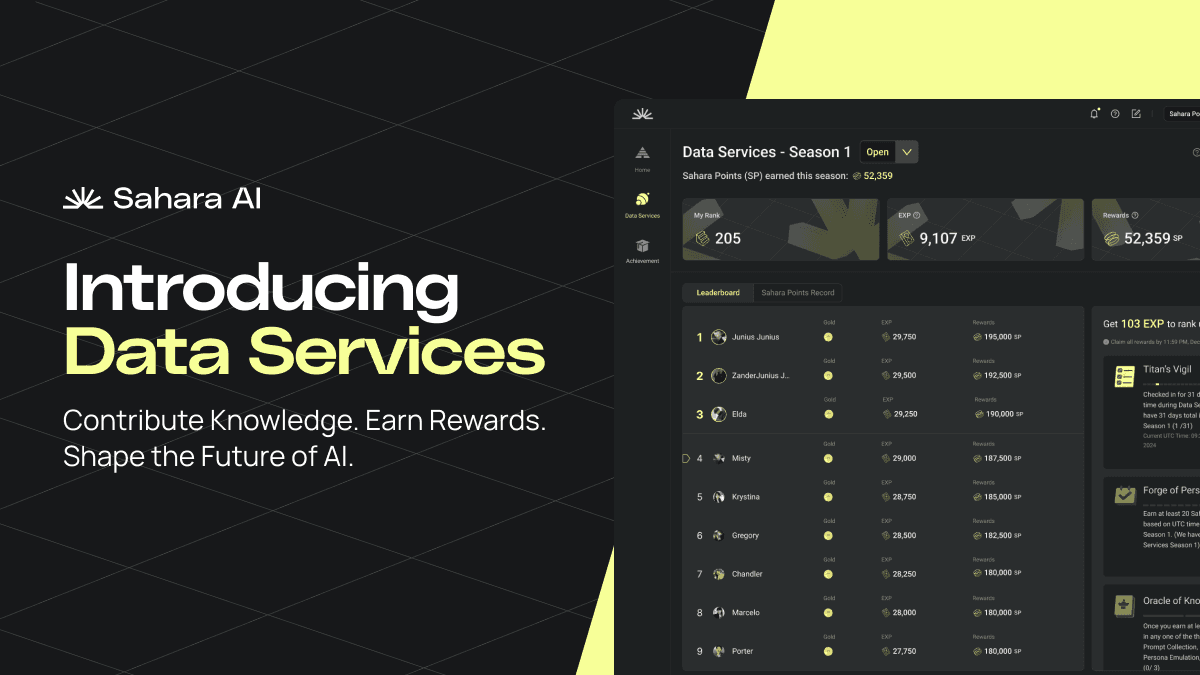
- Sahara AI: Offers over $450K in token bounties paid in $SAHARA tokens or stablecoins for tasks like image annotation and audio transcription. Source

- Oanic AI: Rewards labelers with $OANIC tokens based on accuracy, speed, and consistency; top performers earn up to a 3x multiplier. Website
- Honeybee AI: $HNYB governance tokens grant contributors governance rights and dataset ownership for aligned incentives. Website

- Alaya AI: Employs a token economy rewarding participants with ALA tokens for data labeling tasks, enhanced by gamified badges. Details
- Sapien: Gamified platform with blockchain-based crypto rewards for high-quality data labeling; raised $5M to scale. Source

Pioneering Platforms Redefining AI Training Incentives
Sahara AI stands out with its Data Services Platform, dangling over $450,000 in $SAHARA token bounties for tasks spanning images to audio. Contributors compete in bounties, earning stablecoin options too, which broadens appeal. Oanic AI's $OANIC token ecosystem rewards speed, consistency, and accuracy, with elite labelers snagging 3x multipliers - a clever nudge toward excellence.
Honeybee AI takes it further, granting $HNYB holders governance over datasets and partial ownership, turning annotators into stakeholders. This aligns long-term interests, as quality data boosts token value. Alaya AI gamifies the process with badges and ALA tokens, enabling users like a Spanish medical student to monetize spare moments productively. Sapien's $5M-funded platform blends gaming with crypto rewards, making tedious labeling feel like a leaderboard chase.


These initiatives underscore AI training data incentives at work. Perle Labs adds on-chain reputation, verifiable across projects, while Pundi AI's tag-to-earn model eliminates upfront costs for builders. Privacy-focused platforms employ homomorphic encryption, letting labelers work on shielded data without exposure risks.
Mechanisms That Guarantee Annotation Excellence
Quality isn't assumed; it's engineered. Most platforms deploy multi-stage validation: initial labeling, peer reviews, and AI-assisted checks, with tokens slashed for errors. Oanic AI's multiplier system quantifies this - accuracy above 95% unlocks bonuses, creating a flywheel of improvement. Governance tokens let top earners vote on task priorities, ensuring relevance to real-world AI needs like autonomous driving or healthcare diagnostics.
Educational undertones run deep. Contributors access tutorials and leaderboards, upskilling en route to higher earnings. This meritocracy filters out casual participants, yielding datasets primed for fine-tuning large language models or vision transformers. In my view, this token-driven evolution isn't hype; it's a fundamental shift, making high-quality data abundant and affordable.
Deeper dives reveal nuanced tokenomics. Vesting schedules prevent dump-and-run behavior, while burn mechanisms tie supply to usage. For blockchain projects, this means leaner operations: no massive labeler payrolls, just fluid token flows.
These tokenomics create a virtuous cycle: high-quality annotations drive platform adoption, which appreciates token value, rewarding early and diligent contributors. From a value investing lens, this mirrors compounding returns in undervalued assets - patience in consistent labeling yields exponential gains as ecosystems mature.
Leading Blockchain-Based AI Data Annotation Platforms and Token Rewards
| Platform | Key Rewards/Features |
|---|---|
| Sahara AI | 💰 $450K bounties in $SAHARA or stablecoins |
| Oanic AI | 📈 3x multipliers for high accuracy |
| Honeybee AI | 🗳️ governance tokens & ownership stakes |
| Alaya AI | 🎮 ALA tokens with gamification |
| Sapien | 🏆 $5M funding, competitive leaderboards |
Diving into specifics, Sahara AI's bounty model suits high-volume tasks, distributing over $450,000 in $SAHARA tokens or stablecoins to ensure broad participation. Oanic AI differentiates with performance tiers; labelers hitting 95% accuracy and optimal speed capture those coveted 3x multipliers on $OANIC rewards, quantifiable proof that crypto rewards for data labeling sharpen skills over time. Honeybee AI's $HNYB introduces skin-in-the-game ownership, where annotators influence dataset curation, fostering loyalty akin to shareholder alignment in traditional firms.
Alaya AI's ALA token economy turns idle time into income, as seen with that medical student in Spain tagging radiology images during commutes. Sapien's gamified interface, backed by $5M, deploys crypto leaderboards to sustain engagement, while Perle Labs builds portable on-chain reputation - a credential that travels, much like a CFA designation boosts career mobility. Pundi AI's tag-to-earn sidesteps builder costs entirely, channeling user enthusiasm into zero-overhead datasets.
Privacy innovations add another layer. Platforms integrating homomorphic encryption allow secure labeling without data exposure, vital for sensitive sectors like healthcare or finance. Federated learning complements this, aggregating insights sans central data hoarding. These decentralized AI data labeling features mitigate risks that plague centralized giants, from breaches to monopolistic pricing.
Navigating Challenges in Token-Driven Ecosystems
No revolution lacks hurdles. Token volatility can deter conservative contributors, though stablecoin options and vesting mitigate this. Sybil attacks - fake accounts gaming rewards - demand robust KYC-light verification, often via zero-knowledge proofs. Quality variance across global talent pools requires adaptive training modules, ensuring a Nairobi developer matches a Silicon Valley expert.
Regulatory fog looms too; as tokens blur lines between incentives and securities, platforms must navigate compliance without stifling innovation. Yet, DAOs offer a nimble response, with community governance adapting faster than corporate bureaucracies. Analytically, these frictions pale against upsides: error rates plummet to sub-2%, scalability surges via millions of micro-contributors, and costs drop 40% per industry reports.
Consider the flywheel effect. Superior datasets train sharper AI models, attracting more projects and token demand. This self-reinforcing loop undervalues early entrants, much like spotting blue-chip stocks pre-breakout. For AI crypto projects, it's a no-brainer: outsource annotation to token-powered crowds, reclaiming focus for model innovation.
Looking ahead, interoperability beckons. Cross-chain bridges could unify reputation scores, letting a Sahara AI veteran jump to Oanic tasks seamlessly. Integration with layer-2 scaling will slash gas fees, unlocking mobile-first labeling in emerging markets. Gamification evolves too, with AI tutors personalizing challenges, turning novices into pros.
Ultimately, token incentivized data labeling rearchitects AI's foundation. Blockchain doesn't just fund annotations; it engineers trust at scale. Builders gain pristine data cheaply, contributors unlock borderless income, and tokens appreciate through utility. In volatile markets, this convergence of AI and crypto stands as a disciplined bet - where quality inputs yield outsized, sustainable returns.




No comments yet. Be the first to share your thoughts!